Next: Lagrange Multipliers Up: Functions of Several Variables Previous: Directional Derivatives and the Contents
To find critical points we need to solve the system of equations  and
and  . Let
. Let
 .
.

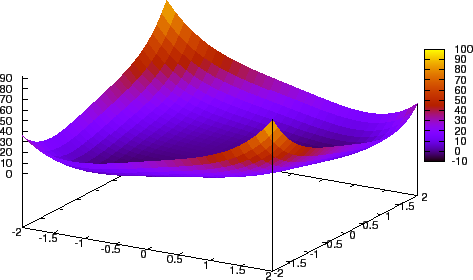
Let's take a look at a plot of  .
.
![\begin{maximasession}
load(draw);
draw3d(enhanced3d = true, explicit(f(x,y), x, ...
...eft[ \mathrm{gr3d}\left(\mathrm{explicit}\right) \right] \\
\end{maximasession}](img130.png)
See Figure BLANK.
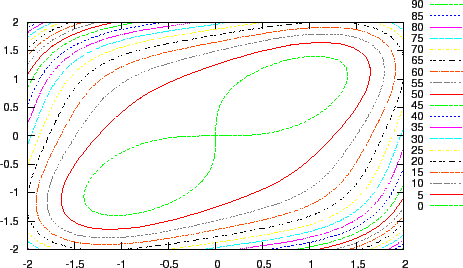
Now let's take a look at a contour plot of . We do it just like the plot of the surface, except we use the argument contour = map.
![\begin{maximasession}
draw3d(explicit(f(x,y), x, -2, 2, y, -2, 2),
contour = ma...
...eft[ \mathrm{gr3d}\left(\mathrm{explicit}\right) \right] \\
\end{maximasession}](img132.png)
See Figure BLANK.
Now let's find the first order partial derivatives of , set them equal to zero, and solve for values of  . We do this with the solve function, which assumes that the expressions are set equal to zero by default. Keep in mind that solve finds all real and complex solutions; we only care about the real valued solutions, however, and will ignore the rest.
![\begin{maximasession}
fx : diff(f(x,y), x);
fy : diff(f(x,y), y);
solve([fx,fy],...
...ft[ x=1 , y=1 \right] , \left[ x=0 , y=0 \right] \right] \\
\end{maximasession}](img134.png)
Critical points are at  ,
,  , and
, and  . (Note that both partial derivatives exist everywhere.) We need to see what the Hessian says at those locations.
![\begin{maximasession}
H: hessian(f(x,y), [x,y]);
determinant(H);
\maximaoutput*
...
...\cr } \\
\i9. determinant(H); \\
\o9. 576 x^2 y^2-64 \\
\end{maximasession}](img138.png)
We do the Second Derivative Test by plugging in the above three points into  and
and
 . (Of course we can do it mentally but let's try it with Maxima.) A quick way to plug numbers into expressions is with the subst function.
![\begin{maximasession}
subst([x = -1, y = -1], diff(fx, x));
subst([x = -1, y = -...
.... subst([x = -1, y = -1], determinant(H)); \\
\o11. 512 \\
\end{maximasession}](img141.png)
From the above we conclude that is a local minimum of , and the value is
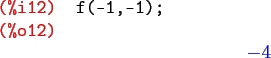
Doing the same for and shows that is a saddle point and is also a local minimum (we know this already by symmetry).