Next: Optimization and Local Extrema Up: Functions of Several Variables Previous: Chain Rule and Implicit Contents
Remember to do load(vect) if you haven't already during the session. By default Maxima assumes that the coordinate system is rectangular (cartesian) in the variables  ,
,  , and
, and  . If you do not want that then you need to change it by means of the scalefactors command.
Given the function of two variables,
 .
.

We change to the correct coordinate system.
![\begin{maximasession}
load(vect);
scalefactors([x,y]);
\maximaoutput*
\i2. load(...
...{}} \\
\i3. scalefactors([x,y]); \\
\o3. \mathbf{done} \\
\end{maximasession}](img119.png)
Next we find the gradient.
![\begin{maximasession}
gdf: grad(f(x,y));
ev(express(gdf), diff);
define(gdf(x,y)...
...=}\left[ 2 x e^{x^2} \sin y , e^{x^2} \cos y \right] \\
\end{maximasession}](img120.png)
The directional derivative of  at the point
  in the direction of the vector
 is
is
![\begin{maximasession}
v: [3,4];
(gdf(1,2) . v)/sqrt(v . v);
ev(%, diff);
float(%...
...over{5}} \\
\i10. float(%); \\
\o10. 2.061108499400332 \\
\end{maximasession}](img122.png)
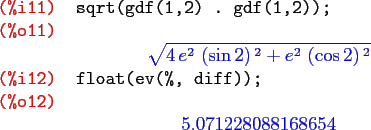
We know from our theory that the directional derivative is maximized when  points in the direction of the gradient, and the maximum value is the length of the gradient vector. Let's see just how big that is.