


Next: Chain Rule and Implicit Up: Functions of Several Variables Previous: Partial Derivatives Contents
A function of two variables is differentiable at a point  when it is closely approximated by the tangent plane to the curve at . We saw in class how to find the tangent plane at , and we also discussed how we could use the tangent plane to approximate values of
  for
for  near .
We will not bother with the tangent plane in Maxima, but we can quickly find the linear approximation  to
to  (which is essentially the same thing) by means of the taylor function.
Let
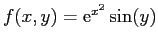 and let us find the linear approximation of at the point
  .
.
![\begin{maximasession}
f(x,y) := exp(x^2) * sin(y);
taylor(f(x,y), [x,y], [1,2], ...
...eft(x-1\right)+\cos 2 e \left(y-2\right)\right)+\cdots \\
\end{maximasession}](img101.png)
The function is shown in the output as everything but the three dots. The ellipsis is a way to indicate that the returned expression is an approximation to the original function.
The linear approximation arguments are all self explanatory except the last. It represents the order of the Taylor series. When we find a linear approximation to a differentiable function what we are actually doing is finding a Taylor series of order 1, about the point .
We can get the total differential by doing diff without specifying any independent variables.

The symbols del(y) and del(x) stand for  and
and  , respectively.