


Next: Functions of Several Variables Up: Three Dimensional Geometry Previous: Vector Valued Functions Contents
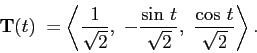
There is no special Maxima function for the curvature but we can do it with the formulas we learned in class. Recall from the last section that
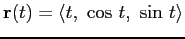 and
and
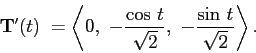
![\begin{maximasession}
r(t) := [t, cos(t), sin(t)];
rp(t) := [1 ,-sin(t), cos(t)]...
...; \\
\o6. \kappa\left(t\right)\mathbin{:=}{{1}\over{2}} \\
\end{maximasession}](img71.png)
We have a lot of practice with derivatives, but we can integrate, too.
![\begin{maximasession}
integrate(r(t), t);
\maximaoutput*
\i7. integrate(r(t), t)...
...
\o7. \left[ {{t^2}\over{2}} , \sin t , -\cos t \right] \\
\end{maximasession}](img72.png)
With integrals we can compute the arc length, but be warned, the arc length may only *rarely* be calculated in closed form. More often than not the arc length can not be represented by an elementary function. We do an example for the sake of argument. We will define a simple vector function, calculate the derivative, and integrate the norm of the derivative.
![\begin{maximasession}
g(t) := [2 * t, 3 * sin(t), 3 * cos(t)];
define(gp(t), dif...
...(t) . gp(t))), t, 0, 2*%pi); \\
\o10. 2\,\sqrt{13}\,\pi \\
\end{maximasession}](img73.png)
Note that we used the special notation %pi for our favorite mathematical constant. We need the same thing for Euler's constant %e and the imaginary unit %i.
Also note that we wrapped sqrt(gp(t) . gp(t)) with trigsimp in the integrate call. As of the time of this writing, there is a bug in Maxima so that the integral is not computed correctly without the simplification. See Bug ID: 2880797 in the Maxima bug tracker.
Especially with arc lengths sometimes we need to do numerical integration instead of symbolic integration. We can do it with the romberg function.
