


Next: Three-dimensional Up: Vector Fields Previous: Two-dimensional Contents
The gradient vector  defines a vector field on the domain of
  . We can plot this vector field in two ways: with the draw package, or with the ploteq function.
First we need a gradient function. Let's start with
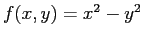 . Then, of course,
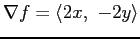 .
.
![\begin{lstlisting}[basicstyle={\ttfamily }]
kill(f, x, y, gdf);
f(x,y) := x^2 - ...
...grad(f(x,y));
ev(express(gdf(x,y)), diff);
define(gdf(x,y), %);
\end{lstlisting}](img199.png)
Next we make the plot. (We have omitted the first few lines because we will use the same values from the last example. However, these lines should not ordinarily be skipped).
![\begin{lstlisting}[basicstyle={\ttfamily }]
vf2d(x,y) := vector([x,y], gdf(x,y)/...
...);
apply(draw2d, append([head_length=0.1, color=blue], vect2));
\end{lstlisting}](img200.png)
Alternatively, we can do it in one line with the ploteq function as long as we remember to put a minus sign in front of the original function (ploteq plots vectors that are the opposite of gradient vectors).
![\begin{lstlisting}[basicstyle={\ttfamily }]
ploteq(-(x^2+y^2),[x,y],[x,-4,4],[y,-4,4],[vectors,''blue'']);
\end{lstlisting}](img202.png)
